
3 Important Reasons Neurodivergent Kids Need Homeschool Screen Time
Hey, just so you know … This post includes affiliate links. That means if you use them to make a purchase, I may earn a commission. You can read my full affiliate disclosure HERE.
Welcome to the #TechieHomeschool IRL blog series! In this post, my guest Lindsay shares 3 reasons to consider utilizing screen time to support your neurodivergent kids in your homeschool.

Technology gets a bad wrap. This is especially true in some homeschool circles.
“I don’t want my child learning from a screen.”
Well-meaning in their concern, some homeschool parents avoid technology and continue with traditional methods. While it may not be a bad decision, it could be the wrong choice depending on the student.
Many kids with learning, behavioral, emotional, or other executive functioning challenges do best with screen-based learning. Do you have a child who thinks and processes the world differently?
- ADHD
- Autism
- Anxiety
- Dyslexia
- Dysgraphia
- Or just resists learning
If so, it’s important to consider alternative and more effective ways to educate your neurodivergent child. After all, you don’t want to leave effective educational resources on the proverbial table, right?
So today, I’m sharing 3 reasons why you should consider screen time to support your child in reading, writing, and math.
Let’s get started.
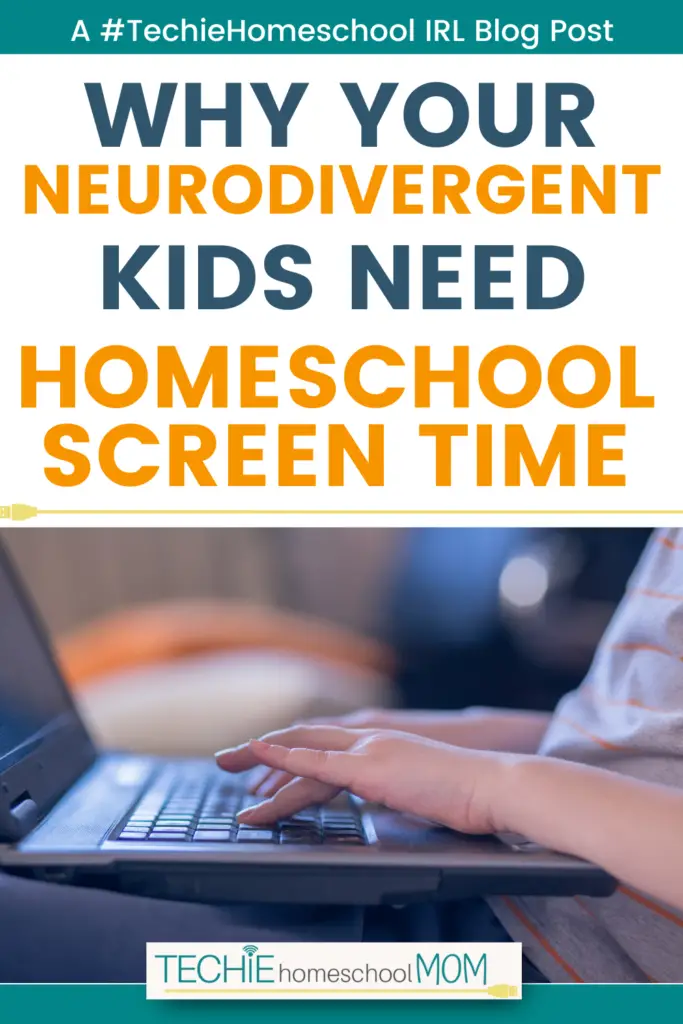
Screen Time for Reading
When I first started homeschooling 13 years ago, my mission was to get my oldest child to read. I know I’m not alone. We homeschool moms know the value of a solid foundation in reading. However, the truth is many children struggle with reading.
Fortunately, if your child has a learning difference such as dyslexia or ADHD, using screens can be a vital tool to support your child’s reading skills.
Additionally, if your child with executive functioning challenges has difficulty taking direction from you, screens can help. Support your child by “removing the audience” and giving them agency.
Screen-based learning can give them the independence they need to learn more effectively. Here are a few ways to do this.
Turn on Subtitles
Turn on the subtitles on all screens and streaming channels your child uses.
Doing so supports auditory and visual processing of words and corresponding text. Over time, this can really help your child in reading and spelling.
Use Videos
Use engaging phonics-based videos to teach foundational reading skills.
For example, the LeapFrog series is a phenomenal resource to teach:
- letter sounds,
- blends,
- digraphs,
- vowel teams,
- and more.
When you need your child to learn independently, turn on LeapFrog.
Read to a Device
Allow your child to read to and record with a device. Often, neurodivergent kids are consumed with fear and anxiety related to making mistakes.
This makes it extra stressful for them to read in front of an audience. And often, that audience includes you.
If your child doesn’t like reading in front of you, OR if you want to increase reading practice but are pressed for time, try this. Have your child read and record their reading practice to their device.
- In an Ipad, hit record in the voice memo app.
- Then have your child read and record.
- Once they’re done reading, have them listen to themselves reading while they read with their eyes.
This exercise allows them to hear themselves from a different perspective. Further, it’ll help them catch their own mistakes without feeling ashamed.
Doing this will likely increase your child’s attention to quality of reading and motivate them to improve. (In the end, there’s nothing more important than a child’s internal sense of motivation to thrive as a student.)

Screen Time for Writing
Many children struggle with writing. In fact, I’d go so far as to say many children HATE it. Whether it’s basic printing skills in kindergarten, or writing full blown-essays in middle school, writing can be a HUGE battle.
Additionally, kids with learning differences often have dysgraphia, a neurological disorder that impacts the physical act of writing. Again, this makes writing even more difficult.
If and when your child resists writing, whether diagnosed dysgraphic or not, remove barriers such as the physical act of writing. Here are a few ways to use technology and screens to remove writing barriers.
Speech to Text
Allow your child to use speech to text when working on any “writing” assignment. This frees up energy in the brain to focus on the learning objective. Specifically, developing ideas and then choosing language to express those ideas.
Here’s a couple ways to do this.
- Add Google Drive to your child’s device.
- Allow them to speak their thoughts and ideas directly into Google Docs.
- Or use Siri and the notes section of your child’s Ipad or Iphone.
Once this step has been completed, your child can then work on the next step.
Use Grammarly
Add Grammarly to the laptop your child uses for schoolwork.
Using Grammarly is NOT cheating. It’s an excellent tool for resistant writers or struggling learners for a couple reasons.
- As with everything you teach your child, focus on the learning objective. In this case, the objective is NOT spelling or handwriting. The learning objective is “writing” or more specifically, “communicating thoughts and ideas to a reader.”
- Using a tool like Grammarly removes a learning barrier. Integrating penmanship, spelling, the formulation of ideas and language all at once can be a losing battle for many kids.
- Grammarly allows your child to learn without the added pressure of doing it perfectly. Later, work on those subject areas in isolation while allowing your student to take their first steps in the writing process.
Use Screen Time for Math
As I mentioned earlier, lots of kids with ADHD, Autism, dyslexia or other learning challenges struggle taking direction from others. This can lead to a lot of stress on the parent-child relationship dynamic.
One major contributor of homeschool parent-child stress is math. Again, this is when giving your child agency and independence can really help.
Online Math
Try using an online homeschool math curriculum such as CTC Math.
CTC math is excellent for neurodivergent learners for a few reasons. Specifically,
- short lessons,
- minimalistic design,
- and a clear to-the-point teaching.
If your child wants you with them while they learn, you still can. You can “learn” along with your child by sitting with them to watch the teachings. This still keeps you out of the authoritative teacher role while allowing you both to keep up with the teaching.
…RELATED POSTS…
Online Math Curriculum Options You Need to Consider
Youtube Math Videos
Use Youtube to access solid math videos that your resistant student will LOVE.
If your child is learning elementary-level math, try NumberJacks or Numberblocks.
Both programs are highly engaging and teach foundational math concepts such as:
- Number bonds
- Place Value
- Squares and Numbers to 100
On the other hand, if your child is tackling higher-level math including algebra, give Mathantics a try.

Recap: Use Screens for Kids with Learning Differences
For kids with learning challenges like ADHD, Autism, Dyslexia or dysgraphia, homeschooling provides endless opportunities to thrive.
However, there’s a lot of pressure on the homeschool parent to provide this quality education. At the same time, they often struggle with pressure to “keep kids off screens” when using screens could be the key to best equip their child.
In the end, some of the best reading, writing, and math teaching tools are screen time based technology. If your child struggles with academics, emotional regulation, or behavior, using quality screen-based teaching tools can improve your child’s educational success by increasing independence. Further, the independent learning provided by such educational homeschool tools can increase your child’s internal sense of motivation as a learner.
So, Friend, what types of screen-based teaching tools work best for your neurodivergent learner?
About the Author

Lindsay Leiviska
Lindsay Leiviska is a wife, mom of three, and a trauma-informed educator with a Master’s Degree in Teaching. She’s worked with children for over 20 years and been homeschooling her own kids for more than 12.
In 2013, Lindsay and her husband adopted a newborn boy. Their son’s adoption and transition into their family radically transformed her as a mom and educator.
Lindsay is founder ofA Heart For All Students, with a mission to support moms raising and homeschooling children with ADHD, Autism, Anxiety and other complex backgrounds. She believes in equipping kids with exactly what they need to thrive as who God designed them to be.
Techie Homeschool in Real Life Series
This post is part of the Techie Homeschool in Real Life blog series. If you are looking to increase your homeschool tech knowledge, you won't want to miss any of the guest posts! Learn more about the series and read all of the other posts included here.
Techie Homeschool in Real Life Sponsors
This series would not be possible without the support of it's sponsors. I am encouraging you to visit each of them listed below to learn more about their company, product, or curriculum, and how they can enhance your techie homeschool journey!










Enter the Series Giveaway!
Thanks to our sponsors, we have some amazing prizes to give away during this series both here, as well as in the Facebook group and newsletter. You won't want to miss any of it!
Here, you can enter to win one of TWO $200 Giftogram Gift Cards. The winners will have over 200 brands to choose from when selecting their gift card.
Use the KingSumo form below to claim as many entries as you can to get in on this amazing giveaway. Each blogger represented on the entry form has contributed to make this series happen, so definitely take the time to do all of the entries (someone’s gotta win this thing – could be you!).

Giveaway ends February 28, 2023 at 11:59pm CT. Must be at least 18 years of age. Must be a resident of U.S. to enter. Selected winner will have 48 hours to respond to email notification to claim their prize, or another winner will be drawn.

Want some techie homeschooling tips and inspiration delivered to your inbox? Sign up here for weekly-ish emails from me.
Techie Homeschool Mom is a participant in the Amazon Services LLC Associates Program, an affiliate advertising program designed to provide a means for sites to earn advertising fees by advertising and linking to Amazon.com. You can read my full affiliate disclosure HERE.








My daughter has dyslexia. She does fine with direction from others but has found many ways to use screens to work around things, She finds her lines for her theatre productions online and records them so she can listen over and over.
Thanks for sharing this. I appreciate the ideas.
I have learned to love screen time for my neurodivergent children! You’re right – it does help alleviate the stress when using it to teach a concept we’re butting heads over, and the idea of using a recorder for oral dictation for my reluctant reader has been something we’ve been investigating lately – all great tips! Thanks!
We love technology in our homeschool, but if I’m not diligent about checking in with them or having them out in the open/same common area… there will be dawdling.
I never thought of having my child record herself reading. It may just work for my reluctant reader!
Thank you!